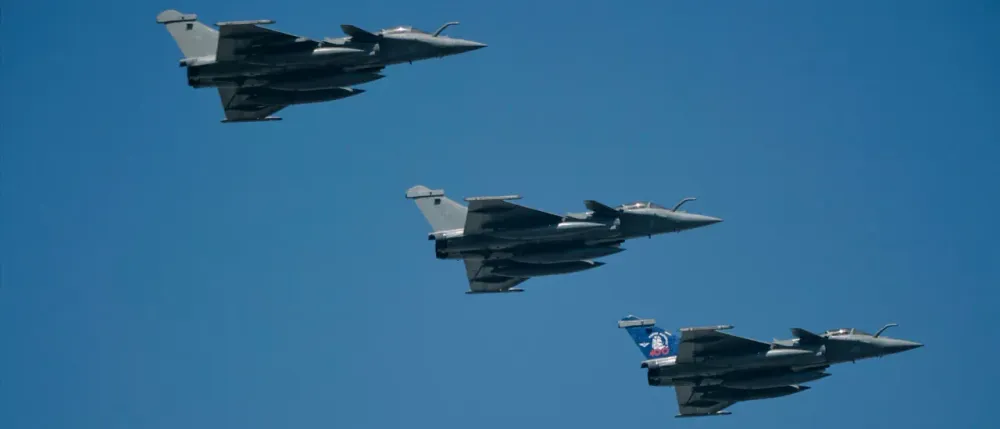
A wider European role for French forces
President Emmanuel Macron's "forward deterrence" initiative has attracted the United Kingdom, Germany, the Netherlands, Belgium, Poland, Greece, Finland, Norway, Sweden, and Denmark, according to The Wall Street Journal.
The proposed cooperation extends beyond aircraft deployments. The Journal reported that it includes building infrastructure and establishing communications, early-warning, and intelligence-sharing links between France and its allies. French nuclear-capable Rafale fighters would also deploy across Europe under the plan.
France has been discussing arrangements with each partner separately rather than bringing all participants into collective negotiations. Senior defense officials told the Journal that the other governments have consequently been comparing notes about what Paris has told them.
A NATO official emphasized that the initiative would supplement the alliance's existing deterrent. "France's forward deterrence initiative further adds to and complements NATO's nuclear deterrence; it does not replace it," the official told the Daily Caller News Foundation. France retains independent nuclear forces and sets its own doctrine, the official added, leaving French authorities to explain the specific arrangements.
The Journal, citing military officials and analysts, identified a distinction from U.S. nuclear-sharing arrangements: France's ASMP-A nuclear-armed cruise missiles are intended to reach targets far inside Russia, including major cities.
Partners outline cooperation and limits
Finland joined the initiative on September 14, 2026, its embassy confirmed to the Daily Caller News Foundation. President Alexander Stubb said the effort strengthens European security, gives Europe greater responsibility for its own defense, and helps prevent escalation.
Stubb also set a limit on Finland's participation: it has no plans to station nuclear weapons on its territory during peacetime. He said Finland nevertheless intends to create a "strategic dilemma" for Russia and described the initiative as probably a 10- to 15-year process. "We don't know where this is going to end," he said.
Germany and France have established a nuclear steering group to discuss deterrence, according to a joint statement by Chancellor Friedrich Merz and Macron reported by Reuters. They said concrete cooperation would begin in 2026, with conventional German forces taking part in French nuclear exercises and the two sides conducting joint visits to strategic sites.
The broader effort comes amid European doubts about U.S. nuclear security guarantees and renewed concern about a possible Russia-NATO nuclear conflict, according to the European Parliament. Jeff Knopf of the Middlebury Institute of International Studies told the Daily Caller News Foundation that perceptions of a greater Russian threat after the invasion of Ukraine, uncertainty about U.S. reliability, and France's ambition to take a central role in European defense all help explain the initiative.
A larger arsenal with less public disclosure
Macron announced the planned stockpile increase in his March 2, 2026, speech at Île Longue. According to the Élysée Palace, he also said France would no longer publish its warhead count, ending its previous disclosure practice.
The Federation of American Scientists estimates France's military stockpile at 290 nuclear warheads, compared with approximately 4,400 for Russia and 3,700 for the United States. Reuters describes France's arsenal as the world's fourth largest and reports that maintaining its 290 submarine- and air-launched weapons costs roughly 5.6 billion euros, or about $6.04 billion, annually. Britain has 225 nuclear warheads, according to Reuters.
In the March speech, Macron said one French ballistic-missile submarine carries firepower equivalent to all the bombs dropped on Europe during World War II, close to a thousand times the power of the first nuclear bombs. He also announced that the next French ballistic-missile submarine, L'Invincible, would take to the water in 2036.
"If we had to use our arsenal, no State, however powerful, could shield itself from it; and no State, however vast, could recover," Macron said.
Disagreement over the nuclear risks
Russian Foreign Ministry spokeswoman Maria Zakharova called Macron's decision to expand the arsenal an "extremely destabilising development." Moscow has warned that a broader NATO nuclear capability could further threaten Russian security.
Robert Peters of the Heritage Foundation offered the opposite assessment, telling the Daily Caller News Foundation that the initiative reduces nuclear risks. He called it a measured response to Russian nuclear coercion and Russia's refusal to de-escalate and disarm its theater nuclear forces.
Philipp Bleek of the Middlebury Institute said that, if the initiative works as intended, it would make nuclear war with Russia less likely by complicating Moscow's calculations about nuclear threats and attacks. He said it could ease tensions within Europe and NATO, while cautioning that "there's certainly potential for the opposite, too."
David Swanson of World BEYOND War argued that stationing French nuclear weapons in other countries would violate the Nonproliferation Treaty. He said such deployments would increase the danger of accidental or intentional use, intensify hostility, and fuel an arms race.
Matthew Wallin of the American Security Project pointed to the expiration of New START in 2026 without a replacement. With Russia and the United States having allowed the agreement to lapse, he said, "there is currently nothing holding back an arms race." He also warned that more nuclear weapons generally mean greater risks of accidental use or unintended escalation.
Alistair Burnett of the International Campaign to Abolish Nuclear Weapons described both the arsenal expansion and discussions about using territory in countries bordering Russia for nuclear-armed aircraft as escalatory. He urged diplomacy and de-escalation rather than counter-threats. Burnett called Macron's rhetoric "self-indulgent sabre-rattling" and said that, although justified by reference to Russia and doubts about U.S. reliability, it also reflects France's long-standing ambition to lead a Europe more independent of the United States.