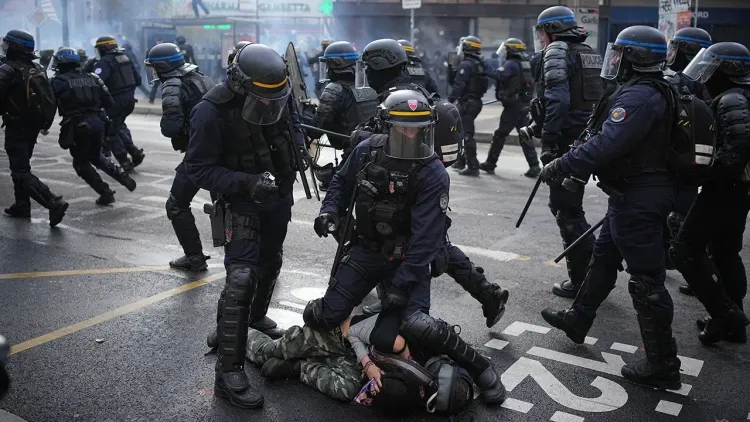
From school grievances to nationwide marches
The movement began on September 21, 2026, at Lycée Antoine-de-Saint-Exupéry in the Paris suburb of Créteil, according to Wikipedia's account of the protests. Students initially challenged teacher shortages, crowded classrooms and deteriorating buildings. Trade unions and the "yellow vest" movement later joined as the demonstrations expanded to address living costs.
For October 17, Interior Minister Laurent Nuñez reported 550,000 participants across 110 marches, with 110,000 in Paris. Organizers, including the CGT union, put nationwide attendance at 800,000. Prime Minister Sébastien Lecornu subsequently reported about 1,200 arrests and injuries to 150 police officers and gendarmes that day.
By October 22, the nationwide arrest total had reached 2,700, Justice Minister Gérald Darmanin said. More than 1,000 people had appeared in court, and 217 had received jail sentences following fast-track trials.
Writing in Independent Australia, political economist William Briggs describes police using water cannons, stun grenades and tear gas. He rejects portrayals by some government figures and media outlets that reduce the demonstrations to student unrest or the actions of "anarchists."
Spending cuts alongside rising borrowing costs
France's proposed 2027 budget would reduce spending by about €54 billion relative to earlier plans, DW reports. About €5.5 billion of the savings would come from pensions. The government aims to bring the deficit down from a projected 5.4% of GDP in 2026 to 5% in 2027, although education funding is set to increase by about €1.2 billion.
Briggs argues that reductions on this scale necessarily erode social spending and that the government will not meet the basic needs driving the protests.
France's public debt is about 119% of GDP, compared with roughly 64% in Germany, according to DW. French 10-year government bonds now carry yields about 1.5 percentage points above their German counterparts, the widest gap since the eurozone debt crisis of the 2010s.
Briggs puts France's debt-service bill for the coming year at €65 billion. He cites Bank of France head Emanuel Moulin's warning that the country could be "strangled by interest rates" without action on public finances. Lecornu has also said that geopolitical pressures pushing up interest rates will leave France needing an additional €10 billion next year.
Unrest beyond France
The French demonstrations are part of a broader wave of European unrest. Wikipedia's compilation of reports also identifies protests in Belgium, Albania, Greece, Italy, Portugal, Spain, Austria, Ireland, Serbia and Germany.
Wage restraint and job cuts feature in Briggs' account of the pressures on workers. He points to Volkswagen, a global employer of 665,000 people, which has frozen wage increases until 2030 and already eliminated thousands of jobs.
According to Ground News, Volkswagen confirmed its salary-freeze plans on October 19, 2026. IG Metall labor representatives warned that inflation could leave employees with roughly 10% less real income. The freeze follows a restructuring program targeting about 50,000 job losses by 2030.
The wider debt burden
Briggs connects the unrest to pressure on public finances internationally. He cites IMF figures showing government debt equivalent to 95.3% of global GDP and 108.2% for the most advanced economies. He also notes the IMF's October call for urgent public-spending cuts.
The IMF's October 2026 Fiscal Monitor and an accompanying blog published October 14–15 project that global public debt will exceed 100% of GDP by 2030, returning to a level last seen immediately after World War II. They also forecast that the effective average interest cost of government financing will rise to 3.7% by 2031, from 2.3% in 2021.
Borrowing costs have already climbed: the average yield on G7 10-year government bonds increased by more than one percentage point between February and September 2026, reaching its highest level in nearly two decades, according to the IMF.
Briggs says annual global interest payments now exceed $4 trillion, while total global debt is above $365 trillion and increases by an average of $10 trillion a year. He also identifies investment in AI projects as a contributor to the debt spiral, arguing that their profitability is uncertain while predicting the loss of millions of jobs.
Military budgets and social spending
Briggs argues that military expansion compounds these pressures. With world military spending set to reach $3 trillion this year, he describes war financing as a cycle in which additional debt raises interest costs and prompts cuts to social programs. He links crises in capitalist economies historically to war and warns of a turn toward war and authoritarian rule.
The EU's ReArm Europe plan, also called Readiness 2030, aims to mobilize €800 billion in additional defense spending over four years. According to the European Commission, it combines a €150 billion loan instrument, Security Action for Europe (SAFE), with activation of the Stability and Growth Pact's national escape clause. The Commission estimates that a defense-budget increase equivalent to 1.5% of GDP could open nearly €650 billion in fiscal space over four years.
Briggs characterizes the initiative as an "EU war budget." He also cites a US annual interest bill approaching $1 trillion and says President Donald Trump has declared that military spending requires cuts to social services.
Australia's growing interest bill
Briggs extends his argument to Australia, despite its calmer streets and debt-to-GDP ratio below the global average. He says the IMF's demand for spending restraint also applies there. In his account, the latest federal budget reduced social spending by more than $63 billion while increasing military spending by a corresponding amount.
He contrasts the roughly 1.6% interest rate on Australian government debt during the relatively low-rate period from 2013 to 2021 with an expected rate of 4.8%. Citing Treasury projections, he says debt-interest payments will reach $42 billion in 2029 and become the federal budget's fastest-growing expenditure item.
Australia's current annual interest payments of $29.6 billion already exceed federal spending on either unemployment benefits or childcare, Briggs notes.