Escort fighters and tankers join Rummy
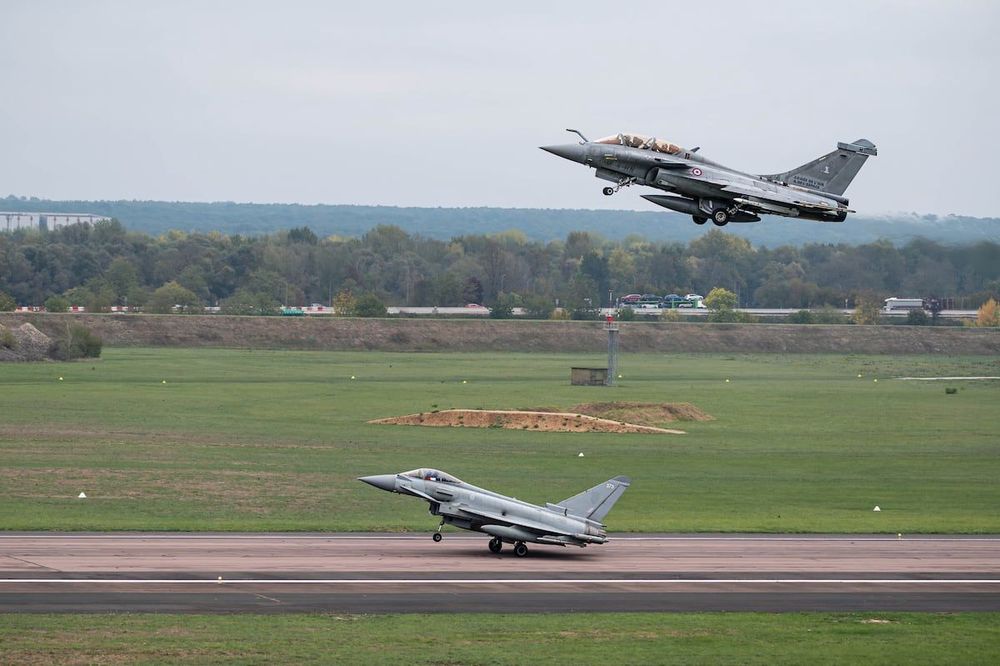
The joint flight took place on October 20 during Rummy, a two-day exercise that ended October 21. Royal Air Force Typhoons provided an escort while Rafales from France's Strategic Air Forces carried out the simulated strike, according to the ministry.
Gen. Fabien Mandon, France's armed forces chief of staff, said A330 MRTT tankers also participated. French and British crews departed from Saint-Dizier air base in northeastern France and demonstrated a "very high level of interoperability and a capability to coordinate," he wrote on X. Images in his post showed three Eurofighters taxiing and a sheltered Eurofighter with RAF 29 Squadron markings.
The British role illustrates an established NATO concept known as conventional support for nuclear operations, or CSNO, according to AeroTime. Under that approach, conventional forces assist a nuclear mission without carrying nuclear weapons. Fighter escorts are one form of support; others can include aerial refueling, electronic warfare and suppression of enemy air defenses.
Etienne Marcuz, a senior analyst at the Fondation pour la Recherche Stratégique, described the exercise on X as a break with the Strategic Air Forces' practice of operating autonomously since their creation in the 1960s. He called the participation of at least three British Eurofighters "quite significant."
Different nuclear forces, separate decisions
Both countries operate nuclear-armed strategic ballistic-missile submarines. France also fields an airborne deterrent, using Rafales equipped with nuclear-tipped cruise missiles, while Britain currently has no airborne nuclear component.
France's Strategic Air Forces operate about 40 nuclear-capable, two-seat Rafale B fighters, according to AeroTime. They serve in the EC 1/4 "Gascogne" and EC 2/4 "La Fayette" squadrons at Air Base 113 Saint-Dizier. In March 2025, President Emmanuel Macron announced plans to restore a nuclear mission at Air Base 116 Luxeuil, with two additional Rafale squadrons by 2035. That expansion would effectively double the nuclear-capable Rafale fleet over time.
Britain plans to buy 12 F-35A fighters for NATO's nuclear-sharing mission, with deliveries expected to begin in the early 2030s, AeroTime reports. That future RAF role would depend on weapons under U.S. custody and control, unlike France's sovereign airborne deterrent. Britain's independent nuclear deterrent remains submarine-based.
The French ministry stressed that cooperation does not mean joint authority over nuclear use: each country retains sovereign forces and its own decisions. Both would consider using nuclear weapons only in "extreme circumstances of legitimate defense," it said. French Armed Forces Minister Catherine Vautrin argued that coordination between independent forces could strengthen the alliance's security and Euro-Atlantic peace and stability.
From observers to a joint mission
The ministry linked Rummy to the Northwood Declaration, the 2025 agreement to deepen British-French nuclear cooperation and coordination. It described the exercise as an important step toward implementing that agreement and demonstrating a shared determination to deter common threats. The declaration states that no extreme threat to Europe would fail to prompt a response from both countries.
An earlier step came on December 10, 2025, when the UK-France Nuclear Steering Group established by the declaration held its first meeting in Paris. Senior officials from the UK Cabinet Office and the Presidency of the French Republic jointly chaired the meeting, according to the Cabinet Office.
On that occasion, British officials were allowed to observe Operation Poker, marking the first access granted to foreign officials to observe France's strategic nuclear airborne component. Poker is France's recurring simulated nuclear-strike drill; AeroTime reports that it rehearses every stage of a nuclear raid four times a year.
France's wider European deterrence effort
The cooperation is developing as France works with European allies on "forward deterrence," against a backdrop of uncertainty over U.S. security guarantees for Europe and an aggressive Russia. Macron announced the concept at the Île Longue submarine base on March 2, 2026.
The French Armed Forces Ministry says the approach will develop gradually, with arrangements tailored to individual partners. Possible activities include joint exercises, strategic signaling outside France, allied conventional forces supporting French nuclear activities and, ultimately, temporary deployments of elements of France's strategic forces to allied territory. Authority to decide on French nuclear use would remain exclusively French.
Along with the UK, Germany, Poland, Sweden, Denmark, Greece, the Netherlands and Belgium have agreed to an in-depth strategic dialogue with France, according to the ministry.
Germany has also taken steps toward closer cooperation. French Rafales and German Eurofighters conducted a joint air activity in July 2026, and Berlin confirmed plans to join a French nuclear exercise before the end of 2026, AeroTime reports.